



Structural strengthening of the Atocha Train Station
The intervention forms part of Phase 2 of the Construction Project for the New Railway Complex at Atocha Station, specifically involving the partial demolition of the RENFE service building and the structural adaptation of the elements that remain in service. This is required to maintain the operation of catering services through the gallery adjoining the building to be demolished, until their subsequent relocation and the full demolition of the structure.
Project Description
Situation
The structural issue arises as a direct consequence of the partial demolition of the RENFE service building, as this operation significantly alters the original load-bearing scheme of several beams that must be retained. Initially, these beams functioned as continuous elements with multiple intermediate supports, allowing for a more favourable distribution of forces. However, once these supports are removed during demolition, the beams begin to behave as simply supported elements.
This change results in a significant increase in positive bending moments at mid-span, as well as higher shear forces in areas close to the supports. Consequently, the existing reinforcement—designed for the original structural system—may be insufficient to withstand the new load demands, particularly in bending and shear.
Problem
The structural issue arises as a direct consequence of the partial demolition of the RENFE service building, as this intervention significantly alters the original load-bearing scheme of several beams that must be retained. Initially, these beams functioned as continuous elements with multiple intermediate supports, allowing for a more favourable distribution of forces. However, once these supports are removed during demolition, the beams begin to behave as simply supported elements.
Solution
The solution adopted in the project consists of implementing structural strengthening using carbon fibre reinforced polymer (CFRP) systems, specifically designed to restore and enhance the load-bearing capacity of the affected beams.
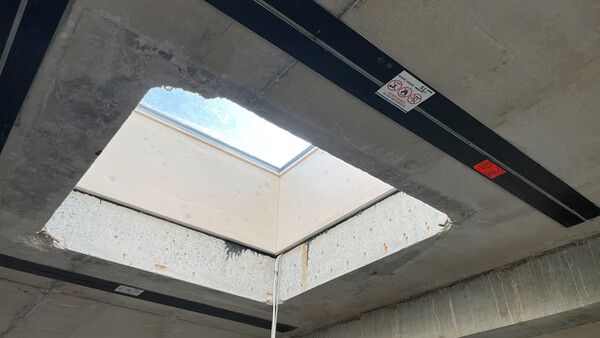
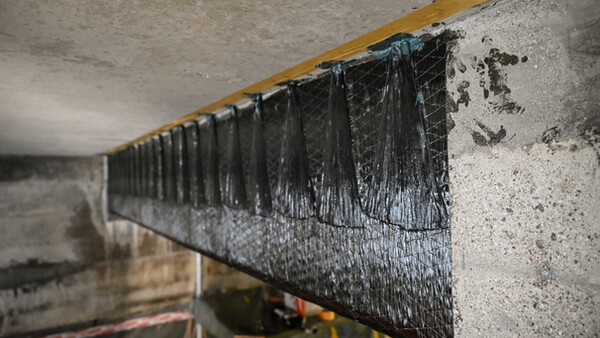
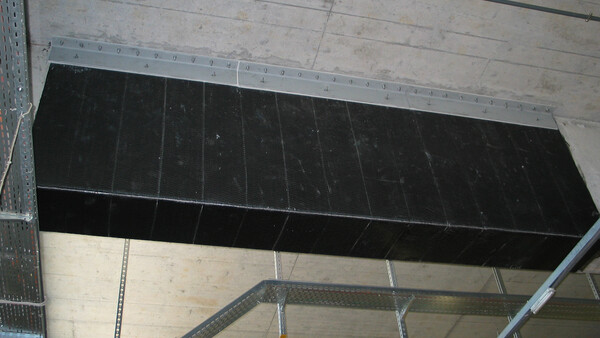
On the one hand, flexural strengthening is provided through carbon fibre laminates bonded to the underside of the beams, with the aim of resisting the increased tensile stresses caused by higher positive bending moments at mid-span.
On the other hand, shear strengthening is achieved using carbon fibre fabrics applied to the sides of the beams, primarily in the end thirds and near-support zones, where shear forces are greatest.
Additionally, during the execution phase, temporary propping is installed beneath the beams to ensure structural stability until the CFRP system has been fully applied and validated.
In summary, the adopted solution enables the existing structure to be adapted to the new load-bearing configuration resulting from the demolition, ensuring the safety and stability of the remaining elements without the need for invasive modifications to the original geometry.
Material
Flexural strengthening: S&P C-Laminate SM 100/1.4, S&P C-Laminate SM 120/1.4 and S&P C-Laminate HM 120/1.4.
Shear strengthening: S&P C-Sheet 240 (600 g/m²), anchored to the beams using S&P C-Anchor with a diameter of 10 mm and a length of 280 mm.